Context Engineering for AI Agents: Why Prompts Are Just the Starting Point

The AI coding agent is the most powerful tool since the text editor. But here's what nobody told you: the real bottleneck isn't how smart your model is — it's how much useful context you can get into its context window before it starts making things up.
Prompt engineering focuses on writing and organizing model instructions. Context engineering extends that work to the information, tools, and history supplied throughout an agent’s runtime.
This guide breaks down what context engineering means in 2026, the five patterns that actually matter, and how to build systems that scale beyond what any single prompt could achieve.
The Three-Layer Evolution
The field has evolved through three layers, which overlap rather than making the previous layer obsolete:
Layer | Question it answers | Tooling |
|---|---|---|
Prompt Engineering | "How do I phrase this to get what I want?" | Prompts, few-shot examples, system messages |
Context Engineering | "What do I need to give the model to succeed?" | RAG, memory, tool descriptions, project memory, system prompts |
Harness & Loop Engineering | "How do I build the system that does all this?" | Agent loops, schedulers, verifiers, state files, hooks |
In 2024, a great prompt could carry you. In 2026, the model is the engine — the harness is the car. If you're not building the harness, you're just holding the steering wheel while someone else drives.
The shift happened because agents stopped being toys. They now run for hours, touch real systems, and need to survive context windows filling up, tools failing, and information becoming stale. A static prompt alone does not provide the runtime mechanisms for managing context, tool failures, and durable state.
What Context Engineering Actually Means in 2026
By 2026, context engineering is no longer just "better prompting." It's the complete discipline of managing what information the model sees, when it sees it, and in what form.
The 2025 arXiv survey (2507.13334) breaks it into three foundational components:
Context retrieval and generation — pulling in the right information at the right time. This includes RAG pipelines, memory systems, and dynamic context assembly based on the task.
Context processing — how context is structured, represented, and transformed. Not just "here's a blob of text" but "here's the relevant code, the failing tests, the last 10 PR comments, and the design doc."
Context management — compaction, pruning, and lifecycle. The hardest problem: context rot. As sessions grow, earlier instructions get lost or retrieved incorrectly. A good harness actively manages context size and relevance.
The Microsoft Azure SRE Agent team found this the hard way. Their first version used 100+ bespoke tools — each with its own API, schema, and failure mode. When they rebuilt it to expose everything as files (source code, runbooks, query schemas, past investigation notes), the agent could use read_file, grep, find, and shell instead of specialized tool interfaces. In its Azure SRE Agent harness account, Microsoft reports improved internal “Intent Met” scores on novel incidents after exposing the agent’s world as files. This is a team-reported result for that system, not a general guarantee.
The lesson: Don't build 100 custom tools. Expose everything as files and let the agent read, search, and navigate — the way human engineers already work.
Pattern 1: The Filesystem-as-Interface
The filesystem is the universal interface. It's what every engineer knows. It's what survives context compaction. It's what works across tools.
Here's what this looks like in practice:
project/
├── CLAUDE.md          ← Project conventions, style guide, "we don't do X"
├── PLAN.md            ← Current task breakdown and status
├── IMPLEMENT.md       ← Implementation notes, decisions, gotchas
├── DOCUMENTATION.md   ← Architecture decisions, design rationale
├── runbooks/
│   ├── onboarding.md
│   ├── troubleshooting.md
│   └── incident-response.md
├── src/               ← Source code (the agent reads this directly)
├── tests/             ← Test files (the agent runs these)
└── logs/              ← Historical context, past investigations
Instead of a tool called query_db_connection_pool_stats, you expose infra/pool-stats.json and let the agent read_file. Instead of get_recent_deployments, you expose deployments/log.jsonl. The agent already knows how to read files — you don't need to teach it another interface.
Anthropic’s context-engineering account discusses compaction, structured note-taking, and multi-agent architectures. Persisting findings in project files and loading relevant instructions are practical design choices, rather than a prescribed list of filenames.
Pattern 2: Memory Externalization (The Sixth Primitive)
A fresh model invocation needs its context supplied. Agent runtimes can restore conversation history or external memory between runs; durable state is a design choice, not an absence of memory in every product.
This guide groups agent infrastructure into six useful building blocks:
Automations / Scheduling — the heartbeat (cron,
/loop, GitHub Actions)Worktrees — parallelism without chaos (git worktree isolation)
Skills — persistent memory of intent (AGENTS.md, CLAUDE.md, skill files)
Plugins & Connectors (MCP) — bridge to external tools and systems
Sub-agents (Maker/Checker Split) — separate creation from verification
Memory / State — external, durable state that outlives sessions
Memory isn't a nice-to-have. It's what happens when you try to run agents for more than one session. A long-running workflow can use three project artifacts:
Plan.md — task breakdown, dependencies, current status
Implement.md — implementation notes, decisions, trade-offs
Document.md — architecture decisions, design rationale, what was learned
These files are the agent's persistent brain. They're what gets read at the start of each run ("where did we leave off?") and written at the end ("here's what I did and what's next").
The agent forgets. The repo doesn't.
This is why STATE.md is the cornerstone of loop engineering — it's the single source of truth that survives across all agent sessions, tools, and models.
Pattern 3: The Maker/Checker Split
The agent that wrote the code is a terrible judge of its own work. This isn't a flaw — it's a fundamental asymmetry. The implementer knows what they intended; the checker evaluates what actually shipped.
This is the adversarial code review pattern: different agents (or at least different model instances with different instructions) for creation and verification. The checker's default stance is REJECT.
Harness configuration and verification can affect outcomes, but a benchmark score alone does not isolate the effect of a separate checker. Treat the maker/checker split here as a workflow recommendation and evaluate it on your own tasks.
The anti-pattern to avoid is loop engineering anti-pattern #1: the same agent implementing and verifying its own work. This is how you get "it works on my machine" merged into production.
A proper maker/checker setup looks like:
Session 1 (Implementer): Writes code, runs tests, creates PR
Session 2 (Verifier): Reviews PR, runs expanded test suite, checks for edge cases
Session 3 (Gatekeeper): Final human approval or auto-merge with allowlist
Each session uses different model instances, different instructions, and different tools. The verifier has no stake in the implementation's success.
Pattern 4: Protocol Interoperability (MCP + A2A)
One of the biggest bottlenecks in 2025 was tool sprawl — every framework had its own way to connect agents to tools, databases, and external services. The solution isn't better prompts; it's better protocols.
Model Context Protocol (MCP) — developed by Anthropic, now open-sourced. A standardized way to expose prompts, resources, and tools to LLM-based agents. Compatible frameworks can reuse MCP interfaces instead of inventing a separate integration for each tool.
A2A (Agent2Agent Protocol) — An open protocol initiated by Google for agent-to-agent communication. Enables agents to discover each other, negotiate tasks, and hand off work without knowing each other's internals.
The convergence is notable: both Claude Code and OpenAI Codex have landed on very similar primitives, so the "loop shape" is becoming tool-agnostic. When you notice the shape is the same, you stop arguing about which tool and start designing loops that work regardless of the underlying agent runtime.
Pattern 5: Skills as Intent Debt Payment
When an agent starts without restored context, missing intent can get filled with confident guesses. Skills are how you pay down this intent debt — conventions, build steps, and "we don't do it this way because of X incident" written once, read every run.
A skill file (typically SKILL.md + optional scripts/references) encodes:
Project conventions (style, architecture, testing standards)
"We don't do X because of Y incident" (hard-won lessons)
Build/test/lint commands (so the agent doesn't guess)
Review standards (what passes, what gets rejected)
Domain knowledge (the stuff you wish every new engineer knew on day one)
Without skills, loops re-derive everything from scratch on every run. With skills, the loop builds on accumulated organizational knowledge.
A reusable harness can express this: the harness carries an organization's nonfunctional requirements, with reusable AGENTS.md/CLAUDE.md artifacts, playbooks, evals, and domain modeling docs. The goal is to make organizational judgment cumulative across agent-maintained repositories.
Putting It All Together: The 2026 Agent Stack
Here's what a production-grade agent system looks like in 2026:
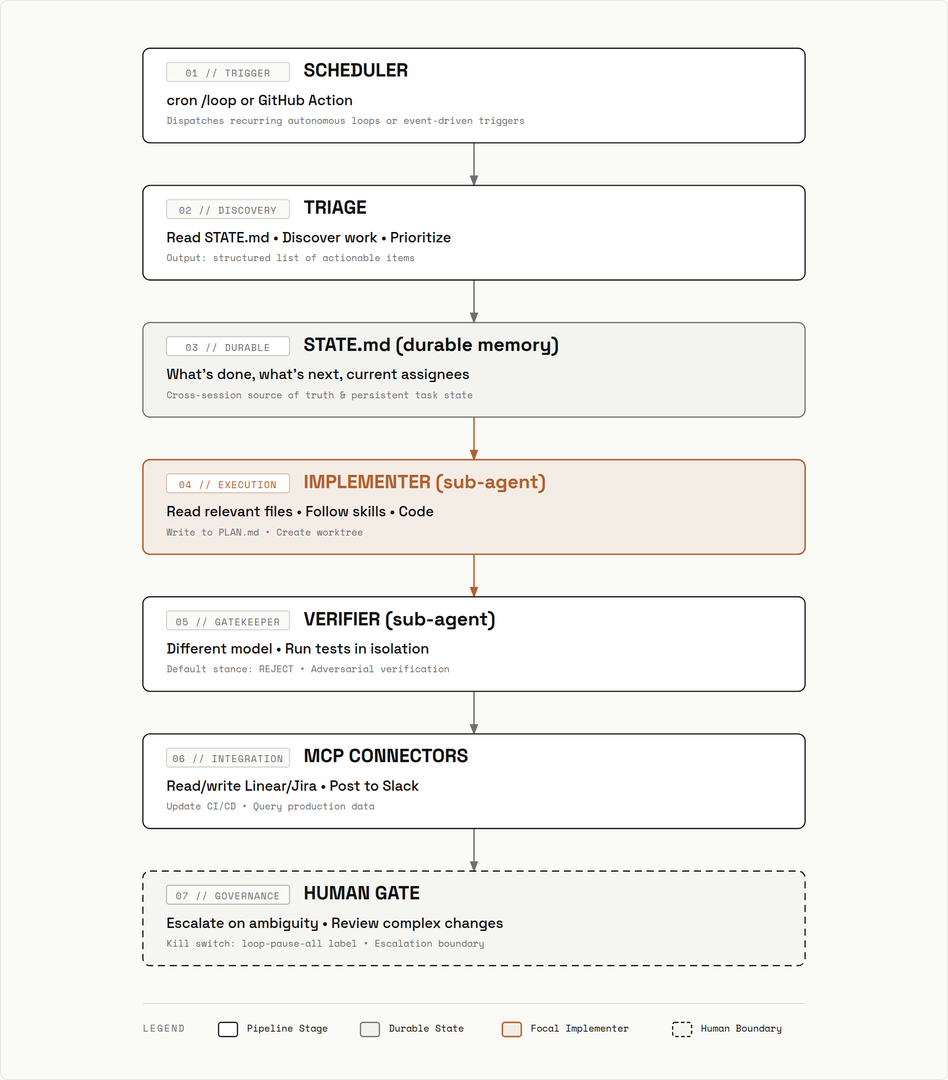
The key insight: token costs can explode in this stack. Best practice is triage first — spawn sub-agents only when state says actionable. For an empty watchlist, exit early; choose and measure a token budget appropriate to your runtime.
What This Means for You
The era of "write a prompt and get a result" is ending. What replaces it isn't more prompting — it's system building. The leverage has moved from prompt engineering to harness engineering.
Three things matter now:
Externalize everything. If intent is not persisted and restored, the agent may not have it on the next run.
Separate creation from verification. The implementer cannot grade its own homework.
Design for cost, not just correctness. Every loop needs a token budget and a kill switch.
The tooling has matured — Agent runtimes offer different combinations of scheduling, tools, skills, memory, and verification. Check the features and access available in your chosen runtime. The differentiator isn't which tool you use. It's how much of your organizational judgment you've encoded into the system so the loop can make better decisions while you sleep.
Harness engineering is learning to stop prompting and start designing.
Related reading: >Awesome Context Engineering · >Loop Engineering patterns · >A2A Protocol