Hermes Agent vs Claude Code: A Developer's Honest Comparison
Here's a number that stopped me mid-scroll: in the first quarter of 2026, a new open-source agent framework called Hermes hit 90,000 GitHub stars in 45 days. Claude Code, meanwhile, crossed $2.5 billion in annualized revenue and now accounts for roughly 4% of all public GitHub commits. These aren't competing products in the traditional sense — one is a self-hosted, self-evolving agent platform, the other a terminal-native coding specialist. But they're competing for the same thing: where your terminal prompt goes each morning.
I've been running both for the past few weeks. The question isn't which one is better. It's which architecture matches the problem you're actually solving. Here's what I learned.
Two Agents, Two Philosophies
Claude Code and Hermes Agent represent fundamentally different bets about what an AI agent should be.
Claude Code, built by Anthropic, is a deep-coding specialist. It lives in your terminal, understands your codebase through LSP and AST integration, edits files natively, runs commands, and chains tools through the Model Context Protocol. It leads SWE-bench Verified at 87.6% on Opus 4.7 — the industry's hardest test of autonomous bug fixing. It does one thing and does it at an elite level. But when you close your terminal, it stops thinking.
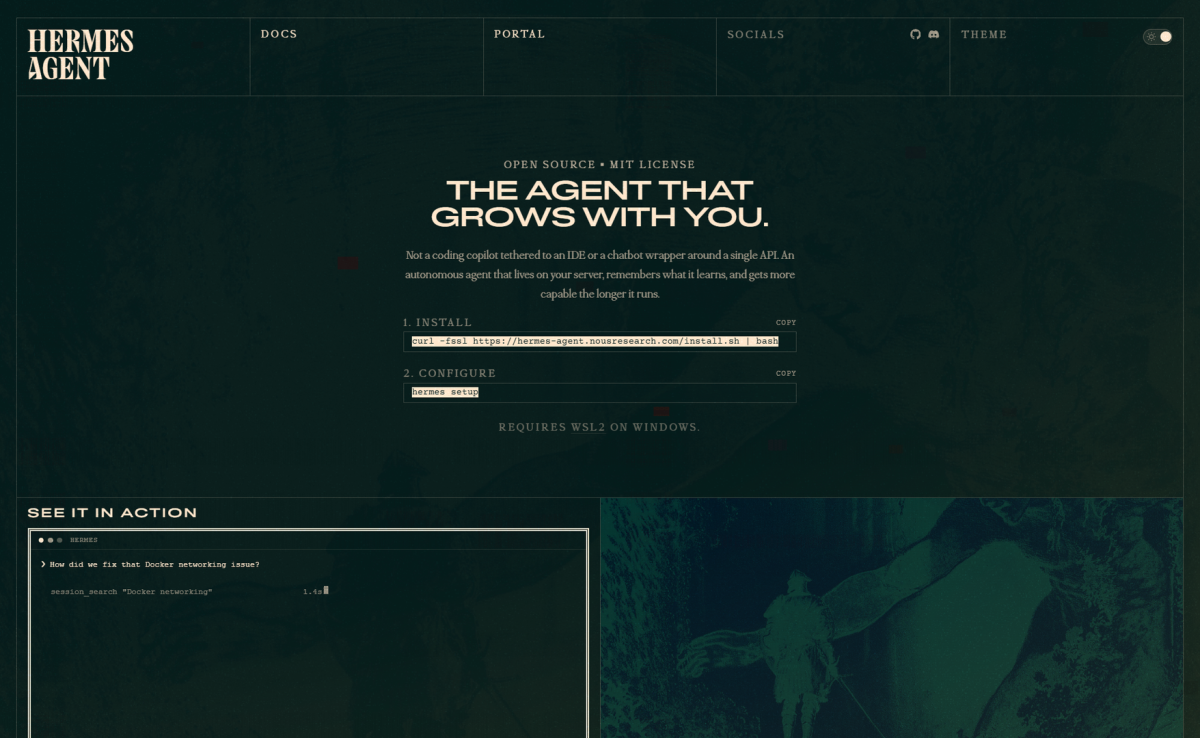
Hermes Agent, built by Nous Research, is a persistent self-evolving generalist. It runs on a VPS, remembers what you told it last week, auto-generates reusable skills from completed tasks, and connects to 16 messaging platforms including Telegram, Discord, Slack, and WeChat. It's model-agnostic — you can point it at Claude, GPT, DeepSeek, or a local Ollama model with a one-line switch. It never stops running. But its coding ability isn't what you'd call elite.
The architectural trade-off is clean: Claude Code trades persistence for depth. Hermes trades depth for breadth and continuity. Neither is wrong. Each is optimal for a different half of a developer's workday.
This split isn't academic — it shapes everything from memory design to deployment patterns.
Memory: The Real Dividing Line
If you strip away the benchmarks and the GitHub stars, the fundamental difference between these two agents comes down to one question: what happens between sessions?
Claude Code's memory is project-scoped and stateless by design. It reads CLAUDE.md files you write manually, stores auto-memory in ~/.claude/projects/memory/, and indexes topics for retrieval. The architecture — revealed in a March 2026 source leak via an npm source map — shows memory as an index layer, not a storage layer. It deduplicates aggressively, prunes stale entries, and consolidates memory separately from the main agent context. Every session loads what it needs and nothing more. This is efficient for coding: you don't want last week's debugging context polluting today's feature branch. But it means the agent doesn't know anything about you that you haven't explicitly put in a Markdown file.
Hermes Agent's memory is a four-layer persistent architecture designed to compound across sessions. The first layer is prompt memory — MEMORY.md and USER.md with a hard 3,575-character cap. The second is a SQLite archive with FTS5 full-text search, storing conversation history that can be queried on demand. The third layer is Skill procedural memory — Hermes only loads skill names and summaries into context, pulling full definitions only when relevant, keeping token consumption constant regardless of how many skills it accumulates. The fourth is Honcho user modeling, which passively tracks your preferences, communication style, and knowledge gaps.
The practical result: after a week of heavy use, Hermes knows which tools you use, how you prefer error messages formatted, and what you worked on last Tuesday. Claude Code arrives fresh to every session, fast and unburdened. For a deep coding sprint, that freshness is a feature. For a long-running automation, it's a dealbreaker.
The memory architecture directly shapes how each agent learns — which brings us to the most debated feature in the agent space right now.
Self-Evolution vs Deliberate Tooling
Hermes Agent's headline feature is its self-evolution loop: observe → execute → reflect → crystallize → reuse. When a task involves five or more tool calls, an error the agent recovers from, or a user correction, Hermes auto-generates a Skill file and stores it. Next time a similar task comes up, it loads the skill instead of reasoning from scratch. The engine powering this is GEPA — Genetic-Pareto Prompt Evolution — an ICLR 2026 Oral paper from Nous Research, combined with DSPy for programmatic prompt optimization.
It sounds incredible. In practice, the results are mixed. The token overhead is real — roughly 73% of each API call goes to context and skill loading before the agent even starts reasoning about your actual task. Some users report that auto-generated skills genuinely compound: a skill written for deploying to a specific VPS, refined across five runs, eventually becomes a reliable one-shot. Others describe a "self-congratulation problem" — the agent believes it performed well and cements a mediocre skill, then overwrites manual fixes on the next run.
Claude Code takes the opposite approach. There's no automatic skill generation. Instead, it gives you MCP (Model Context Protocol) servers, custom slash commands, hooks, and a deliberate plugin architecture. You write the tools. You define the workflows. The system doesn't guess what should be reusable — you tell it explicitly. This is slower to set up, but the tools that result are deterministic. No surprises. No "the agent decided to optimize something you didn't want optimized."
The philosophical difference is stark: Hermes bets that emergent skill extraction beats manual configuration. Claude Code bets that explicit tooling beats black-box optimization. If you're a developer who trusts carefully authored abstractions over learned ones, Claude Code's approach will feel natural. If you want the tool to figure out what's repeatable and handle it for you, Hermes is the more interesting bet.
But the technical architecture is only half the story. The ecosystem dynamics around both tools matter just as much for anyone building on them.
The Ecosystem War
April 2026 was a chaotic month for the agent ecosystem. On April 4, Anthropic added server-side OAuth validation that blocked Claude Code subscriptions from working with third-party tools — including Hermes Agent and OpenClaw. Developers who had been routing Claude's models through Hermes for persistent memory suddenly found their setups broken. Within days, a GitHub repo called hermes-claude-auth appeared, patching Hermes at runtime to pass Anthropic's OAuth content validation by adding the required billing header signature and relocating system prompts to match expected formats.
Days later, Heroku's security team at JFrog discovered a PyPI package called hermes-px posing as a privacy-focused proxy for Hermes Agent. In reality, it was stealing Claude Code system prompts, hijacking a Tunisian university's private AI endpoint, and exfiltrating user prompts to an attacker-controlled Supabase database. The package had been live for weeks.
Then came the plagiarism allegations. On April 15, a Chinese AI team called EvoMap published a module-by-module technical report alleging that Hermes Agent's self-evolution architecture — the 10-step evolutionary loop, the three-layer memory system, and 12 core terms — was structurally copied from their open-source Evolver engine, which had been released six weeks before Hermes' first commit. Nous Research's official account reportedly replied "Delete your account. We're the pioneers" before deleting the response. Co-founder Teknium denied knowledge of the project.
None of this means you shouldn't use either tool. But it means the ground is unstable. If you build deep integrations with either platform, understand that Anthropic's commercial incentives point toward a walled garden, and the open-source agent space is still sorting out where credit ends and copying begins.
The ecosystem noise is loud. The benchmarks, at least, are quieter.
Benchmarks Tell Part of the Story
If you look only at leaderboards, Claude Code wins on code and Hermes wins on memory — but the gaps are different in size.
On SWE-bench Verified, the gold standard for autonomous bug fixing, Claude Opus 4.7 scores 87.6%. Hermes doesn't publish a comparable number because coding isn't its primary use case. On Terminal-Bench 2.0 — practical CLI tasks — the leader is actually OpenAI's Codex at 77.3%, with Claude at 69.4%. Hermes doesn't compete here either. These benchmarks measure coding depth, and that's Claude Code's home turf.
Where Hermes shines is in the benchmarks that Claude Code doesn't attempt. On LoCoMo, which measures multi-session conversational memory across up to 35 sessions and 300+ turns, specialized memory frameworks hit 91.6% accuracy. Hermes's four-layer architecture is built for this workload. Claude Code was explicitly designed not to carry state across sessions.
The gap between benchmarks and daily experience is what matters. Claude Code's benchmark dominance doesn't help when you want an agent monitoring your production logs at 3 AM. Hermes's memory architecture doesn't help when you need to refactor a 50,000-line Go microservice with AST-level precision. The tools are good at different things because they were designed for different things.
Which brings us to the practical question: how do you actually use both?
Building a Stack That Ships
The developers I talk to who are happiest with their agent setup in 2026 aren't using one tool. They're using two or three, each for what it does best.
The pattern that's emerged looks like this: Hermes Agent runs on a $5/month VPS, always on, connected to Telegram and Slack. It handles recurring tasks — daily PR summaries, deployment monitoring, meeting prep from last week's notes, cross-platform notifications. Its memory compounds across these workflows. When you message it on Telegram asking about something you discussed three days ago, it retrieves the context. Claude Code can't do any of this.
Claude Code opens in the terminal when real coding starts. Feature work, complex debugging, architectural changes, multi-file refactors — the work that needs language server integration and a model that leads SWE-bench. It's a tool you reach for, use intensely, and close. The statelessness is a feature here: every session is clean, no accumulated context from monitoring tasks polluting your coding context window.
The handoff between them is where the stack comes together. Hermes stores task context and memory. Claude Code executes the hard coding work. When a Hermes-automated task identifies a bug that needs fixing, it files the issue with context. When you open Claude Code to fix it, you have everything you need without Hermes's token overhead slowing down your coding loop.
This isn't a compromise. It's the architecture that actually maps to how development work is structured — some tasks are continuous, some are intense and episodic, and no single tool optimizes for both.
The question isn't Hermes or Claude Code. It's whether you've designed your workflow so that persistence and depth reinforce each other instead of fighting for the same context window. The developers shipping the most code in 2026 already know the answer.