Real Time Web Search for AI Agent in 2026: The Definitive Guide
You spent three weeks building a sophisticated AI agent. You chose the best orchestration framework, tuned your prompts carefully, and connected it to a capable LLM. Then you shipped it — and watched it confidently tell users incorrect information about things that happened last week.
The failure wasn't the LLM. It wasn't the orchestration layer. It was the search. Most AI agent content focuses on frameworks and prompts, but the community's real pain point, surfaced repeatedly on r/LocalLLaMA and HN, is this: a significant portion of AI agent failures come not from the LLM but from the retrieval stage — bad retrieval leads to bad generation, and bad generation is what your users see.
This guide is about that layer. We'll cover the search approaches that actually work for AI agents in 2026, compare the leading search APIs honestly, walk through self-hosted options, and give you a production architecture you can implement today.
What you'll learn:
Why the search layer is the make-or-break component of AI agents
The honest tradeoffs between managed search APIs (Tavily, Exa, Jina, SerpAPI)
When self-hosted (Perplexica, SearxNG) is the better choice
A production-ready agent search architecture that scales
How to choose the right stack for your use case
Why Your AI Agent Is Only As Good As Its Search Layer
Here's the uncomfortable truth the AI agent community keeps rediscovering: LLMs are not the bottleneck in most agent pipelines. Retrieval is.
When you build a proof-of-concept RAG system, it feels like the LLM is doing the heavy lifting. And it is — for generation. But when your agent confidently cites a source that contradicts reality, or gives outdated information as fact, or hallucinates a company name that doesn't exist — the failure almost always traces back to what the retrieval step found (or missed).
The reason this keeps happening is that most tutorials start with a vector database and static documents. That's traditional RAG. Real-time web search for AI agents is a fundamentally different problem:
Traditional RAG: Your documents → indexed → retrieved → generated. Documents are stable. Chunking strategy matters. Embedding model matters.
Real-time search RAG: The web → queried → scraped/summarised → generated. The data changes constantly. Results vary by search engine. Scraping JavaScript-heavy pages is hard. Attribution to live sources is required.
When your agent needs to answer questions about recent events, current prices, today's news, or live product data, you can't pre-index your way out of the problem. You need to search.
That's what this guide covers.
The Search Approaches for AI Agents
Before comparing tools, it helps to understand the three architectural approaches to AI agent search — because the right choice depends on your use case, not a benchmark score.
Approach 1: Managed Search APIs
The simplest path. You call a third-party API that handles crawling, indexing, and result delivery. The API returns structured search results (titles, snippets, URLs) that your agent uses as context.
Best for: Teams that want to ship fast, don't want to maintain infrastructure, and can accept API costs at scale.
The tradeoffs: You depend on the vendor's index freshness, coverage, and reliability. You're also paying per query, which can surprise you at high volume.
Approach 2: Self-Hosted Search Engines
You run your own search infrastructure using open-source tools like SearxNG or specialized crawlers, with results fed directly to your agent.
Best for: Teams with privacy requirements (no data leaving their infrastructure), compliance needs (GDPR, HIPAA), or cost constraints at scale.
The tradeoffs: You own the infrastructure, the freshness, and the failure modes. Setup is non-trivial. Coverage depends on your crawler configuration.
Approach 3: Custom RAG Pipeline
You build a full retrieval pipeline — crawl your target sources, index into a vector database, and handle ranking and freshness yourself. This is how serious production agents are built.
Best for: Enterprise teams with specific data sources (internal knowledge bases, proprietary documentation) that need to be combined with live web search.
The tradeoffs: Significant engineering investment. Requires ongoing maintenance of crawlers, index freshness pipelines, and reranking logic. Not a weekend project.
Most teams starting out should evaluate managed APIs first, move to self-hosted if privacy or cost is a blocker, and build custom RAG only when the other approaches genuinely can't serve their use case.
Managed Search APIs Compared: Tavily vs Exa vs Jina vs SerpAPI
Here's the honest comparison the community keeps asking for. No vendor marketing — just what practitioners report.
Tavily AI — Best for AI Agent Developers
Tavily was built specifically for AI agent use cases, which shows in its design. It returns structured results optimized for LLM consumption, not just raw Google snippets.
Strengths:
AI-optimized results — Tavily's index is specifically tuned for LLM relevance
Fast time-to-answer — results are pre-processed for summarization, reducing the context your LLM needs to process
Easy integration — dedicated SDKs for Python, TypeScript, and direct LangChain / LlamaIndex connectors
Free tier available for development and small projects
Focused on freshness — actively crawled sources prioritized for recency
Weaknesses:
Smaller index than Google/Bing — niche topics may have spotty coverage
Newer product — less production battle-testing at massive scale compared to SerpAPI
Enterprise features (SSO, SLA) still maturing
Community consensus: Tavily is the most recommended entry point for AI agent developers. The Reddit thread "Tavily vs Jina vs Exa" consistently shows Tavily winning on speed and ease of integration . Best for teams prototyping or running moderate-volume agents.
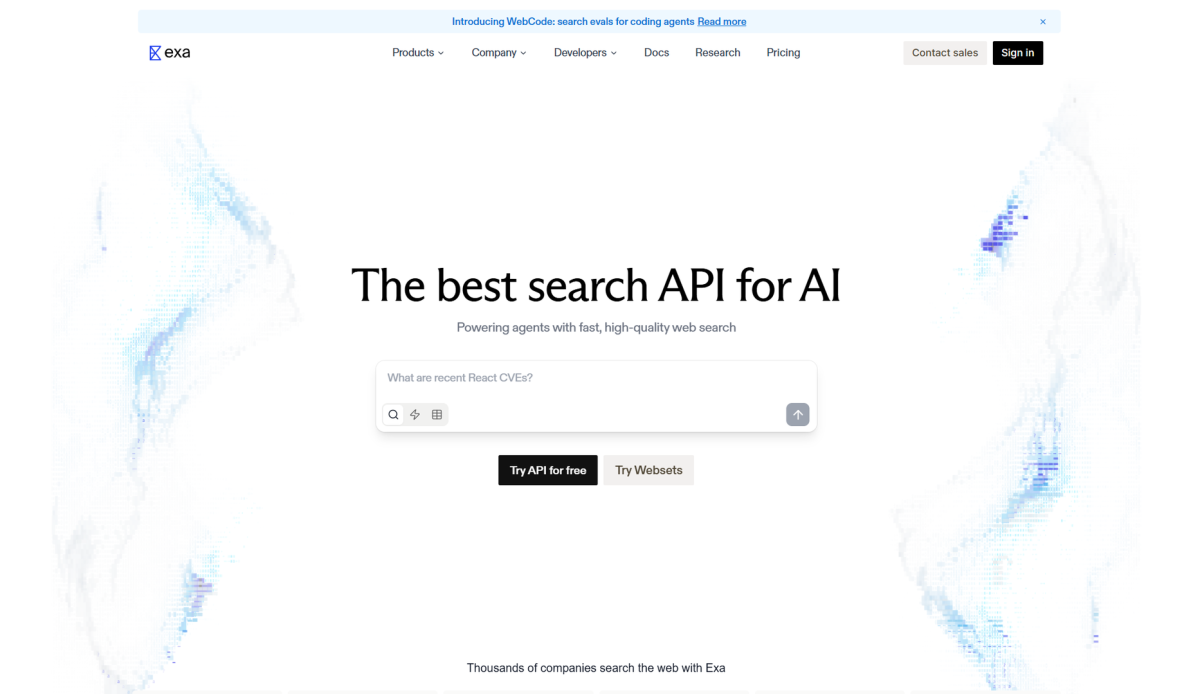
Exa AI — Best for Semantic Depth
Exa takes a different approach — it's built around semantic search rather than keyword matching. It understands the meaning of queries, not just the words.
Strengths:
Superior semantic understanding — Exa returns results based on conceptual relevance, not keyword overlap
Excellent for complex, multi-part queries ("find research papers about transformer efficiency in edge deployment")
Filters by content type, date, and source domain
Strong for academic, scientific, and technical content where simple keyword search fails
Actively developed — frequent updates and new features in 2025–2026
Weaknesses:
More expensive than Tavily at equivalent query volumes
Semantic retrieval can be slower than keyword APIs
Less intuitive for simple factual queries where keyword matching suffices
Community consensus: Exa wins for complex, technical queries and research agents. Practitioners building agents that need to navigate academic content or handle nuanced, multi-part questions consistently choose Exa. Slightly higher cost, but better quality for knowledge-intensive use cases.
Jina AI Reader — Best for Simplicity and Cost
Jina AI offers a reader service that takes any URL and returns structured, LLM-ready content — plus a search API built on top of that infrastructure.
Strengths:
Jina Reader is free — you pay nothing to convert a URL to clean markdown
Excellent for scraping specific pages when you know exactly what you want
Open-source reader available for self-hosting
Straightforward API with good documentation
Weaknesses:
Search API coverage is narrower than dedicated search APIs
Reader-based approach means you're responsible for finding the right URLs first
Best used as a complement to another search layer, not as your primary search tool
Community consensus: Jina Reader is beloved as a free scraping tool, but as a primary search API for agents, it's a complement rather than a standalone solution. The sweet spot is using Jina Reader to process URLs returned by another search engine.
SerpAPI — Best for Structured Google Results
SerpAPI provides structured JSON access to Google, Bing, DuckDuckGo, and other search engines. It's the most established player in this space and the most commonly used in production pipelines.
Strengths:
Direct access to Google search results — the broadest coverage of any option
Extremely mature API — stable, well-documented, battle-tested at scale
Multiple search engines supported — Google, Bing, Baidu, YouTube, etc.
Structured data including
knowledge_graph,rich_snippets, andorganic_resultsGood for competitive intelligence and SEO-adjacent agent use cases
Weaknesses:
Returns raw search results, not AI-optimized summaries — your agent needs to process more context
Google's terms of service restrictions apply — not suitable for all use cases
No built-in LLM optimization — you're getting traditional search results
Pricing can escalate at high query volumes
Community consensus: SerpAPI is the production workhorse. When teams need guaranteed Google coverage and are willing to do more processing on their end, SerpAPI is the standard choice. The community commonly layers SerpAPI behind a faster, AI-optimized tool like Tavily or Exa — using SerpAPI as a fallback when the primary search API returns weak results.
The Quick Comparison
Criteria | Tavily | Exa | Jina Reader | SerpAPI |
|---|---|---|---|---|
AI-optimized | Yes | Partially | No | No |
Semantic search | Basic | Advanced | No | No |
Index size | Medium | Medium | N/A | Very large |
Free tier | Yes (limited) | Limited | Yes (Reader) | No |
Setup speed | Fast | Fast | Fast | Fast |
Best for | Agent prototyping | Research agents | URL processing | Production reliability |
Community rating | Rising fast | Strong | Utility tool | Established |
Self-Hosted: Perplexica and SearxNG
For teams with privacy requirements, compliance needs, or a desire to avoid per-query API costs, self-hosted search is the path. The two tools worth knowing in 2026 are Perplexica and SearxNG.
Perplexica — AI-First Open-Source Search
Perplexica is an open-source AI search engine that aims to replace traditional search with conversational, context-aware answers — not just a list of links.
How it works: Perplexica uses SearxNG as its crawling backend, with an LLM (OpenAI, Ollama for local) providing the synthesis layer. When you query Perplexica, it searches across multiple sources, summarises the findings, and returns an answer — not just a results list.
Strengths:
Fully self-hostable — no data leaves your infrastructure
Open-source and actively developed
Multiple search modes — general, academic, video, image, code, news
Ollama support means you can run the entire pipeline locally (no OpenAI dependency)
Free for unlimited queries
Weaknesses:
Requires your own hosting — a VM, Docker setup, and maintenance responsibility
SearxNG backend means coverage depends on your crawler configuration
More complex to set up than a managed API
Best suited for teams with DevOps capacity
Best for: Privacy-sensitive industries (healthcare, finance, legal), teams with strong engineering capacity, or anyone who wants to avoid per-query API costs at scale.
SearxNG — The Meta-Search Engine
SearxNG is a privacy-respecting meta-search engine that aggregates results from multiple search providers (Google, Bing, DuckDuckGo, etc.) without tracking users.
How it works: You run a SearxNG instance. When your agent queries it, SearxNG distributes the query across multiple search engines, deduplicates results, and returns a unified result set.
Strengths:
Zero cost per query (you host it, you control it)
Aggregates multiple search engines — broader coverage than any single provider
Privacy-respecting by design
Fully customizable — you control which search engines to include
Weaknesses:
Returns raw search results, not AI-summarised content — requires more processing
Google and Bing actively block meta-search engines — coverage is inconsistent
Not designed specifically for AI agents — a general-purpose tool applied to an agent use case
Best for: Teams that need a free, privacy-respecting search backend and are willing to build the synthesis layer themselves. Often used in combination with Tavily or Exa as a fallback.
Tip: A common production pattern is: Tavily or Exa as the primary search → SerpAPI as the fallback → Perplexica or SearxNG as the privacy-respecting alternative. Each layer covers a gap in the others.
The Production Architecture That Actually Works
Here's the architecture that production AI agent teams keep converging on, validated by what practitioners report working in the r/LocalLLaMA production threads.
The Core Loop: Plan → Retrieve → Re-rank → Generate
Modern agentic RAG doesn't just do a single search and generate. It runs a loop:
User query
    ↓
Plan: Break into search sub-queries ("what is X", "current status of Y", "X vs Y comparison")
    ↓
Retrieve: Execute sub-queries in parallel across search APIs
    ↓
Re-rank: Score and filter results by relevance to original intent
    ↓
Generate: Synthesize top results with original query context
    ↓
Response with citations
Key Architecture Decisions
Hybrid search is the baseline. Combine dense vector search (semantic relevance) with sparse keyword search (exact matching). Pure semantic search misses exact entity names. Pure keyword search misses conceptual matches. Hybrid covers both.
Cache aggressively. Search API costs scale with volume. Cache semantically similar queries — not just exact matches. Two users asking "what's the latest on GPT-5?" should share a cached result for at least 15–30 minutes. Set up a Redis or in-memory cache with TTL based on your data freshness requirements.
Use streaming for perceived speed. While your agent is retrieving and processing, stream the LLM's initial response token. This dramatically reduces perceived latency even when actual retrieval time is unchanged.
Monitor retrieval quality separately. Most teams monitor LLM latency and error rates. The failure mode that actually hurts users — bad retrieval — is invisible unless you actively monitor it. Track: search result relevance scores, citation accuracy (did the cited source actually say that?), and rate of "I don't know" responses (a sign your retrieval is failing silently).
Build a fallback chain, not a fallback. Don't route to a single backup search API. Build a chain: Tavily → Exa → SerpAPI → "I couldn't find current information on that." Each layer should have a confidence threshold; if it falls below, the next layer takes over.
The Monitoring Stack
What to actually measure in production:
Metric | Why it matters |
|---|---|
Retrieval precision@3 | Are the top 3 search results actually relevant? |
Citation accuracy | Is the cited source accurate? Sample manually. |
Time-to-first-token | Perceived latency during search-heavy queries |
Search API error rate | Are any search providers failing silently? |
Cache hit rate | Are you paying for queries you could have cached? |
Hallucination rate | Does the agent ever contradict retrieved sources? |
How to Choose Your Search Stack
Answer these questions in order:
Question 1: Do you have specific data sources (internal docs, proprietary content)?
Yes → You need a custom RAG layer on top of any search API
No → Continue to Q2
Question 2: Do you have privacy or compliance requirements (HIPAA, GDPR, no external API calls)?
Yes → Self-hosted with Perplexica + Ollama (fully local)
No → Continue to Q3
Question 3: What's your primary use case?
Prototyping / building fast → Tavily (fastest integration, free tier)
Research / academic / technical queries → Exa (semantic depth)
High-volume production / guaranteed coverage → Tavily + SerpAPI fallback chain
Budget-constrained → SearxNG + custom synthesis layer
Question 4: How much engineering capacity do you have?
High (can maintain infrastructure) → Self-hosted or custom RAG
Medium → Managed APIs with careful monitoring
Low → Tavily or Exa with their built-in SDKs
Pro tip: Start with Tavily. It's the fastest path from zero to a working agent search layer. Measure for two weeks. If you're hitting coverage gaps on niche queries, layer in SerpAPI as a fallback. Only move to self-hosted if you have a specific reason (privacy, cost at scale, compliance) that managed APIs can't solve.
Conclusion
The AI agent search infrastructure space is genuinely mature in 2026 — not perfect, but good enough that teams with a clear use case can build reliable systems. The biggest mistake is treating search as an afterthought after choosing your orchestration framework. In practice, the search layer determines whether your agent is useful or just confident.
The stack that works: start with Tavily as your primary, add SerpAPI as a fallback, monitor retrieval quality separately from LLM metrics, and build a fallback chain that degrades gracefully rather than failing silently. If you have privacy requirements, Perplexica with a local Ollama model gives you a fully self-hosted pipeline that rivals managed APIs.
Your next step: pick one search API and integrate it this week. Two weeks of real usage data will tell you more than any benchmark comparison.
Share your stack in the comments — what search infrastructure are you running for your AI agent? What gaps have you hit?