AI Meeting Note Takers in 2026: Shakeout, Agentic Pivot, and the Privacy Reckoning
A year ago, AI meeting note takers were the hottest productivity tool since Slack. Today, the market is in freefall consolidation — 15+ providers fighting for a shrinking addressable pool, platform giants absorbing transcription as a free feature, and the survivors scrambling to reinvent themselves as "agentic AI" companies before the window closes. Meanwhile, a federal lawsuit against Otter.ai and viral privacy panics across Reddit are forcing a reckoning about what happens to your meeting data.
If you're a developer trying to make sense of this landscape — whether you're evaluating tools for your team or building your own — here's what's actually happening under the noise.
The Great AI Notetaker Shakeout of 2026
The numbers tell a story of brutal consolidation. In the financial advisor vertical alone, 15 AI notetaker providers are jostling for market share, but Jump has emerged as the clear leader at roughly 10% adoption — after a $20M capital raise and the acquisition of Mobile Assistant — with Zocks as a "relatively distant second," according to the Kitces AdvisorTech March 2026 survey.
The squeeze is coming from both directions. On one side, major platforms — Advisor360, Altruist, Wealthbox — have built their own in-house notetakers (Parrot AI, Hazel). On the other, the platform giants have absorbed transcription as a table-stakes feature:
Zoom launched My Notes in February 2026 — cross-platform capture across Zoom, Teams, Google Meet, and in-person meetings, plus Personal Workflows that auto-generate follow-ups.
Cisco Webex shipped Task Agent, Notetaker Agent, and Polling Agent with CRM integrations for Salesforce, Microsoft 365 Copilot, and Amazon Q.
Google Meet's "Take Notes for Me" now works on Zoom, Teams, and in-person meetings, powered by Gemini, dropping notes directly into Google Docs.
Microsoft Teams has a Facilitator agent that tracks decisions, nudges quieter participants, and converts discussions into assigned tasks — without being prompted.
When your core feature ships for free inside the meeting app everyone already uses, differentiation on transcription quality alone stops being a strategy.
The result is a classic winner-take-most shakeout. The Kitces analysis is blunt: "The writing seems to be on the wall… either pivot to a different use case, try to get acquired, or else it will be a hard road ahead." CES 2026 coverage called the category a "shameless money grab" — predatory credit-based pricing, vendor lock-in, and data harvesting dressed up as productivity.
But the shakeout is only half the story. The survivors aren't just making better notes — they're changing what "notes" means.
From Scribe to Executor: The Agentic Pivot
The defining shift of 2026 isn't about transcription quality. It's about agency.
The old model was passive: AI listens, transcribes, summarizes. The new model is active: AI listens, understands what needs to happen next, and goes does it. Zoom calls this Personal Workflows — natural-language automation that drafts follow-ups, updates CRMs, and schedules next steps. Cisco calls it Task Agent. The branding varies but the pattern is identical.
Zeplyn's public pivot from "straightforward AI notetaker" to "agentic AI" is the canary in the coal mine. As InvestmentNews reported in March 2026: when the pure transcription play stops working, you rebrand as an AI agent company. The problem, as Kitces dryly notes, is that agentic tools struggle with the "what problem do you actually solve?" question. A freeform chatbot that can answer any question about your meetings sounds powerful, but users often don't know what to ask.
Still, the trajectory is real. Gartner projects that 40% of enterprise applications will embed AI agents by the end of 2026, up from less than 5% in 2025. Microsoft's Facilitator agent in Teams, Slack's positioning as an "agentic operating system," and Anthropic's Claude Computer Use (launched March 2026) all point toward the same destination: AI that doesn't just tell you what happened, but acts on it.
The market numbers back this up. The agentic AI market was valued at $9.14 billion in 2025 and is projected to reach $139 billion by 2034. The standalone notetaker market? A projected $5-9 billion by 2032 — respectable, but an order of magnitude smaller than the agent opportunity.
The winners in this space won't be the companies with the best transcription accuracy. They'll be the ones that close the loop between "what was said" and "what happens next."
The Privacy Reckoning
While vendors race toward agency, users are sounding the alarm about basic trust.
In August 2025, a California man filed a federal class-action lawsuit against Otter.ai, alleging computer fraud, invasion of privacy, and unfair competition — claiming Otter's Notetaker records and saves conversations without obtaining prior consent from all participants. The case is still making its way through the courts, but the damage to trust is already done.
Across Reddit, IT forums, and Lemmy, a post titled "AI Notetaker Hell" went viral. The core complaint: third-party bots auto-joining confidential meetings — including meetings about student 504 plans protected under federal law — without anyone knowing who invited them or where the audio was going. One r/sysadmin commenter summarized the corporate panic: "If one person in the meeting uses Otter, it's going to automatically record their meetings. The legal liability is incredible — if you haven't blocked it yet, I highly recommend blocking this service before you're hit with lawsuits from employees who did not consent to being recorded."
The Spiceworks IT community documented a cascade of related concerns: bots that rejoin even after being kicked, dark-pattern signup flows that grant calendar and contact access without clear disclosure, tools that detect meeting URLs via browser extension and inject themselves as participants, and the persistent fear of transcripts surfacing in unsecured S3 buckets. One commenter wrote: "It is all fun until everyone's meeting transcripts show up in an unsecured Amazon S3 bucket. I would almost bet money on this happening."
The visible-bot-versus-invisible-capture debate cuts to the heart of the tension. Tools like Fireflies and Otter join as visible participants — transparent, but socially awkward. Tools like Fathom capture locally and invisibly — frictionless, but ethically fraught in two-party consent jurisdictions. A compliance client in one review demanded the tool be removed entirely from an external meeting. Another reviewer put it starkly: "Tools that require upfront communication overhead see usage frequency drop off a cliff. Nobody asks, nobody panics, nobody demands privacy policy explanations — that's the feature."
The American Bar Association weighed in formally, warning lawyers about confidentiality risks when using AI transcription and note-taking software during meetings. The core issue: AI transcripts create time-stamped, searchable, permanent records that wouldn't otherwise exist, and those records are discoverable in litigation.
This privacy crisis is creating an entirely different kind of market: one where the cloud is the problem, not the solution.
The Open-Source Countermovement
If 2025 was the year of the SaaS notetaker, 2026 is the year of the local-first rebellion. A wave of open-source tools has emerged, all built on the same stack — Whisper.cpp for transcription, Ollama for summarization, MIT licensed, zero cloud dependency — and they're gaining traction fast.
Meetily is the most mature. Bot-free, self-hosted, 100% local processing. It captures system and mic audio with no visible bot, runs Whisper.cpp or NVIDIA Parakeet (4x faster, GPU-accelerated), handles speaker diarization, and outputs structured Markdown. Built on Tauri (Rust) + Next.js, it works on macOS, Windows, and Linux. The Show HN thread drew significant attention — the promise of "Fireflies-level utility with zero data exfiltration" resonates.
OpenWhispr takes the same local-first approach but adds on-device speaker diarization with voice fingerprinting, an MCP server for AI agent integration, semantic search across your meeting archive, and a global hotkey for instant dictation. It's cross-platform and supports cloud models as an optional fallback, but the default path is fully local.
Minutes launched in April 2026 as a free-forever alternative to Granola and Otter. It outputs structured YAML — decisions, action items, commitments — that's designed to be queried programmatically. CLI with 15 commands, MCP integration with 15 tools, iPhone voice memo pipeline. MIT licensed.
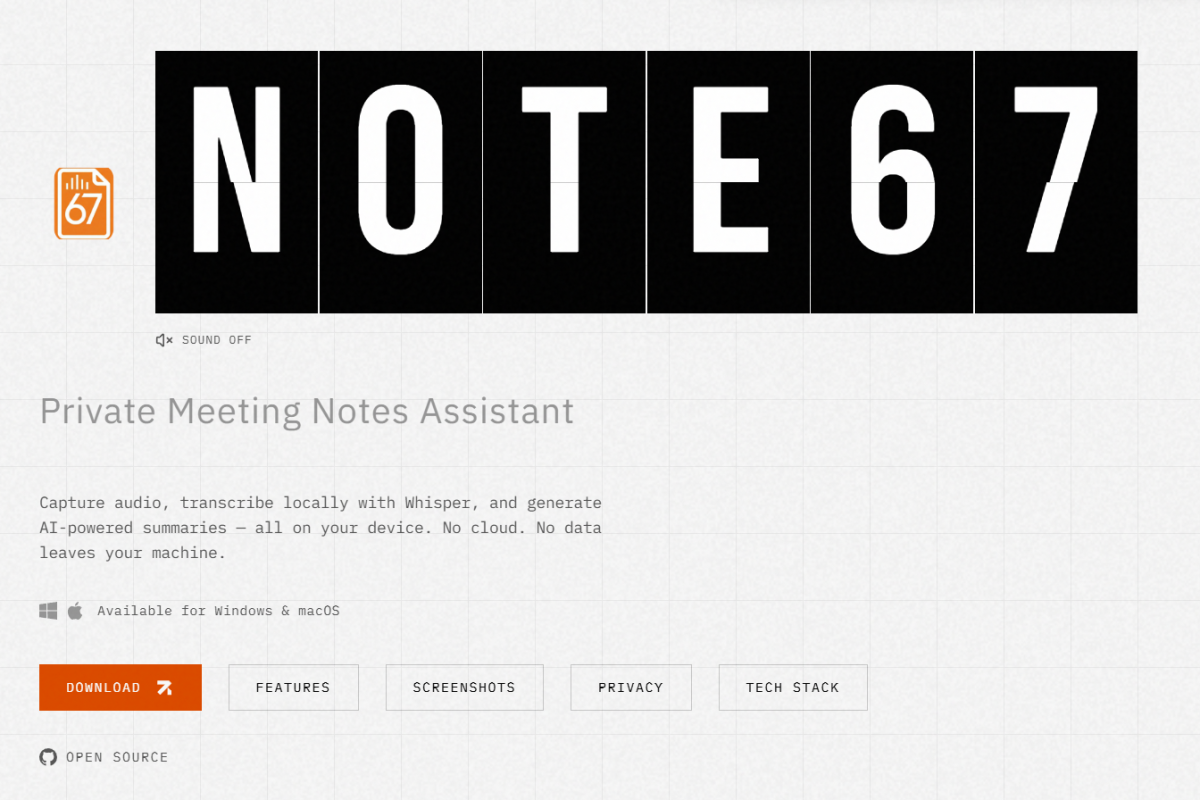
Note67 takes the most opinionated approach: macOS only, whisper-rs for transcription, Gemma3 recommended for summaries, works completely offline after model download. Minimalist by design.
These aren't toys. They're real alternatives for teams that can't or won't ship meeting audio to third-party servers. The tradeoff is accuracy — local Whisper models trail Deepgram and AssemblyAI by 10-15% on real-world meetings — but for routine standups, internal syncs, and any conversation involving strategy or confidential information, the privacy guarantee outweighs the accuracy delta.
The open-source stack is also a building block. Developers are wiring Meetily and OpenWhispr into their own pipelines — capture audio locally, transcribe with Whisper.cpp, summarize with Ollama, push structured output to Notion or a CRM. The entire pipeline runs on a machine the team owns.
What This Means for Developers
If you're a developer evaluating the landscape, the 2026 picture is clearer than it was a year ago. Here's what matters:
Don't bet on a standalone notetaker. The pure transcription market is consolidating to 1-2 winners per vertical, and platform-native tools (Zoom AI Companion, Teams Facilitator, Google Meet Gemini) are already "good enough" for most teams. Pick a tool for its integration surface and API, not its transcription accuracy.
Pay attention to the agentic API layer. The real value isn't in better summaries — it's in what happens after the summary. Which tools let you push structured meeting data into your CRM, your task manager, your Slack channels? Which ones expose webhooks or MCP servers you can build on? The tools that win will be the ones that act as integration hubs, not walled gardens.
The privacy question is a product decision. For internal meetings, local-first open-source tools (Meetily, OpenWhispr, Minutes) are production-viable in 2026. For client-facing meetings where accuracy matters more than privacy, the cloud stack (Recall.ai + Deepgram + LLM) is the pragmatic choice. You don't have to pick one — most teams run both.
The agentic shift is real, but watch the hype. Gartner's projection that 40% of agentic AI projects will be cancelled by 2027 due to cost overruns and unclear value should give everyone pause. The tools that succeed will solve concrete, narrow problems — "update the CRM after every client call" — not vague promises of "autonomous meeting intelligence."
The AI meeting note market in 2026 is a story that repeats across every software category touched by commoditizing AI: the incumbents absorb the basic feature, the specialists differentiate or die, and the developers who pay attention to the API layer rather than the UI layer build the interesting things. The meeting note itself is becoming a commodity. What you do with it is still wide open.