Best Resources to Learn Prompt Engineering
The AI landscape has shifted dramatically in recent years. What started as a niche skill for researchers has become essential for anyone working with large language models. Whether you're building products, automating workflows, or simply trying to get better results from ChatGPT, understanding how to communicate effectively with AI has become a fundamental skill.
Prompt engineering sits at the intersection of communication and technology. It's not about manipulating AI—it's about clear thinking made visible. The better you can articulate what you want, the better AI can deliver. This skill translates across every AI tool you'll encounter.
This guide covers the best resources available in 2026 for learning prompt engineering, from comprehensive courses to community-driven platforms. Whether you're starting from zero or looking to sharpen existing skills, these resources will accelerate your journey.
Why Prompt Engineering Matters More Than Ever
The conversation around AI has matured. In 2026, organizations aren't just experimenting—they're integrating AI into core products and workflows. This shift has created real demand for people who can bridge human intent and machine execution.
Consider what's changed: models have grown more capable, but the fundamental challenge remains the same. Getting the best output from an AI requires clarity of thought and specificity of language. These skills don't replace technical knowledge—they complement it.
What makes prompt engineering valuable isn't some mysterious technique. It's the ability to break down problems, define desired outcomes precisely, and structure requests for optimal results. These skills transfer far beyond AI interaction. They make you a better communicator overall.
Understanding Prompt Engineering Fundamentals
Before diving into resources, let's clarify what prompt engineering actually involves. At its core, it's the practice of designing inputs that produce desired outputs from AI models. This includes choosing the right words, structuring information effectively, and understanding how models process context.
The process typically involves several key steps. First, define the exact output you want—the more specific, the better. Second, craft your prompt using clear language and appropriate structure. Third, test and iterate based on results. Fourth, refine based on model feedback.
This might sound straightforward, but the details matter enormously. Small changes in wording can produce dramatically different results. Understanding why these differences occur—that's where real skill develops.
The applications span virtually every domain. Writers use prompting for drafting and revision. Developers leverage it for code generation and debugging. Analysts use it to explore data and generate insights. The common thread: anyone who communicates with AI benefits from better prompting skills.
Top Courses for Learning Prompt Engineering
Coursera: Prompt Engineering for ChatGPT
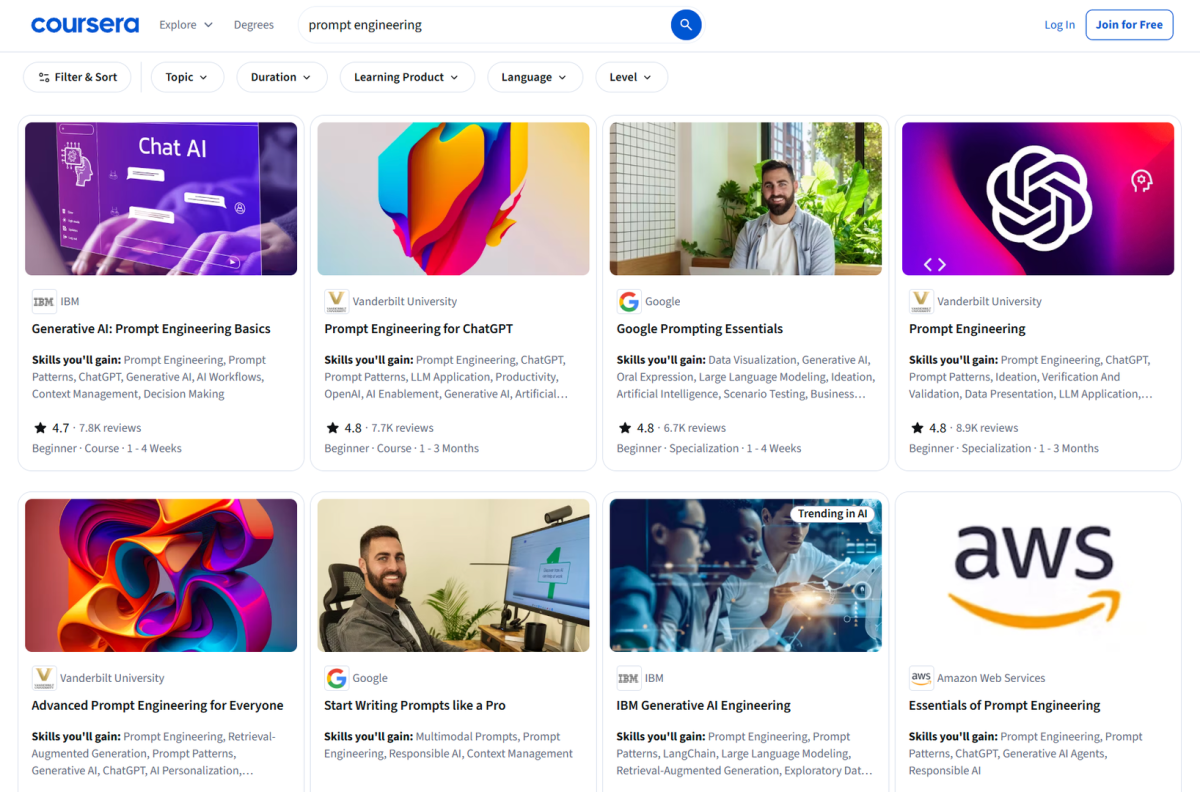
Vanderbilt University offers one of the most popular courses on the platform, specifically focused on applying prompt patterns to real-world scenarios. With over 642,000 enrollments and a 4.79 rating, this course has proven its value at scale.
The course, led by Dr. Jules White, teaches fundamental patterns that work across different AI models. Rather than memorizing specific prompts, you learn the principles behind effective prompting. This approach prepares you for new models and tools as they emerge.
What makes this course stand out is its focus on patterns rather than tricks. You'll learn about classification prompts, information extraction, conversational prompts, and dozens of other patterns. Each pattern addresses specific communication challenges, giving you a toolkit for diverse situations.
The practical assignments matter. You won't just watch videos—you'll build actual prompts and see results. This hands-on component transforms passive learning into practical skill.
DeepLearning.AI: ChatGPT Prompt Engineering for Developers
This free short course from DeepLearning.AI and OpenAI specifically targets developers wanting to integrate prompt engineering into applications. At roughly 90 minutes, it packs substantial value into a compact format.
Instructors Isa Fulford from OpenAI and Andrew Ng from DeepLearning.AI bring unique perspectives. You get insight into how the model was designed to be used, plus practical guidance for production applications.
The course covers four key areas: summarizing text, inferring sentiment and topics, transforming content (translation, tone adjustment), and expanding/generating new content. These core capabilities apply to most real-world use cases.
Particularly valuable is the section on building custom chatbots. The conversational AI space has exploded, and understanding how to structure prompts for dialogue systems directly translates to commercial applications.
Community-Driven Learning Platforms
Learn Prompting
LearnPrompting.org has grown into the most comprehensive free resource for prompt engineering education. With over 60 content modules and 3 million learners worldwide, it offers depth that matches formal courses.
The platform covers all skill levels. Beginners start with foundational concepts. Intermediate learners explore advanced techniques. Professionals dive into specialized topics like AI safety, red-teaming, and agent systems.
What sets Learn Prompting apart is its community aspect. The Discord server connects learners with peers and experts. The HackAPrompt competition challenges participants to push boundaries. This social element keeps motivation high and provides networking opportunities.
The translation into nine languages makes this accessible globally. Quality education shouldn't be limited by language barriers, and Learn Prompting addresses this directly.
Prompting Guide AI
Maintained by DAIR.AI, Prompting Guide AI offers structured documentation alongside practical resources. The site covers dozens of prompting techniques with clear explanations and examples.
The technique documentation deserves special attention. Chain-of-thought prompting, few-shot learning, tree-of-thought reasoning—these aren't just buzzwords. Understanding when and how to apply each technique dramatically improves results.
The Prompt Hub provides categorized examples you can adapt. Rather than starting from blank pages, you can reference proven approaches for classification, coding, creativity, and mathematical tasks. This library grows continuously as the community contributes.
The research section tracks latest developments. Prompt engineering evolves rapidly, and staying current matters. The curated papers and findings help you understand emerging best practices.
Prompt Engineering Organization
This nonprofit organization advances prompt engineering as a field. Beyond education, they support research and community building around the discipline.
The tutorial library offers structured learning paths. Rather than scattered resources, you get curated progressions that build skills systematically. This organization helps if you want depth over breadth.
The case studies section demonstrates real-world applications. Seeing how organizations apply prompt engineering to solve actual problems provides inspiration and practical insight.
Community forums connect practitioners across skill levels. Asking questions and seeing others' challenges accelerates learning. You benefit from collective experience rather than learning in isolation.
Building Your Practice
Resources alone don't build skills. Practice does. Here's how to apply what you learn effectively.
Start with your actual work. Don't practice on abstract examples—apply prompting to problems you face daily. This creates immediate value and deeper learning than artificial exercises.
Keep a prompt journal. Note what works, what fails, and why. Patterns emerge that improve future attempts. This documentation becomes a personal knowledge base.
Join communities. The Learn Prompting Discord, relevant subreddits, and professional networks all provide feedback and ideas. Learning accelerates when you share with others.
Experiment deliberately. Pick one technique per week and apply it consistently. Measure results. This systematic approach beats random exploration.
Teach what you learn. Explaining concepts solidifies understanding. Write tutorials, answer questions, or mentor others. Teaching reveals gaps in your knowledge.
Specialized Areas to Explore
Once you've built a foundation, consider diving deeper into specific areas based on your interests and career goals.
AI Safety and Red Teaming
As AI systems become more powerful, understanding their limitations and potential failure modes grows increasingly important. AI safety focuses on making AI systems reliable, beneficial, and aligned with human values. Red teaming involves intentionally probing AI systems for vulnerabilities, biases, or harmful outputs.
Learn Prompting offers a dedicated AI Red-Teaming & Security Masterclass that covers these topics extensively. Understanding these aspects makes you a more responsible AI practitioner.
Building AI Agents
Agent systems represent a significant evolution beyond simple prompt-response interactions. Agents can take actions, maintain memory, and handle multi-step workflows. The Introduction to Generative AI Agents course on Learn Prompting provides a solid foundation.
The ability to build agentic systems opens new possibilities for automation and productivity. These skills are particularly valuable as organizations look to scale AI capabilities.
RAG and Context Engineering
Retrieval Augmented Generation has become essential for building AI systems that work with specific knowledge bases. Rather than relying solely on model training, RAG allows AI to access external information in real-time.
Context engineering—the practice of structuring and optimizing the information provided to AI models—has emerged as a critical skill. The Prompting Guide AI covers these topics with practical examples.
Real-World Applications
Understanding how prompt engineering applies to actual work contexts helps prioritize your learning.
Content Creation
Writers use prompting for brainstorming, drafting, revising, and editing. The key lies in understanding which tasks benefit from AI assistance and how to maintain your authentic voice. Effective prompting augments creativity without replacing it.
Many content teams now include prompt engineering as a core skill for writers. Understanding how to get the best output from AI tools has become as important as traditional writing skills.
Software Development
Developers leverage AI for code generation, bug detection, documentation, and refactoring. The specificity required for effective code prompting often reveals gaps in your own understanding—another benefit of the practice.
Building AI-powered features requires understanding both prompting and system design. The intersection of software engineering and AI creates new role opportunities.
Data Analysis
Analysts use AI to explore datasets, generate queries, and create visualizations. The ability to prompt effectively accelerates analysis workflows significantly.
Understanding how to structure data context for AI improves results dramatically. This application area combines technical knowledge with communication skills.
Customer Support
AI-powered support systems handle increasingly complex queries. Effective prompt engineering for conversational AI improves resolution rates and customer satisfaction.
The human-AI collaboration model in support combines AI efficiency with human judgment for complex cases.
Measuring Your Progress
How do you know you're improving? Track specific indicators of your prompting capabilities.
Output Quality
Evaluate whether your prompts produce better results over time. Are outputs more accurate, more relevant, more useful? This direct measure reflects your growing skill.
Keep comparison notes. Early prompts and their outputs versus current attempts reveal improvement clearly.
Efficiency
Do you achieve desired results faster? Improved prompting reduces the iteration cycles needed to get good outputs. Efficiency gains indicate deeper understanding.
Versatility
Can you handle diverse task types? Expanding your range from simple to complex applications shows broadening capabilities.
Problem Solving
Can you diagnose why prompts fail and adjust accordingly? This diagnostic ability marks advanced skill development.
Common Mistakes to Avoid
Learning from others' mistakes accelerates your progress.
Treating Prompting as Trickery
Effective prompting isn't about manipulating AI—it's about clear communication. Attempts to trick or jailbreak systems rarely produce useful results and can create problematic dependencies.
Skipping Fundamentals
Jumping to advanced techniques without understanding basics limits long-term growth. The fundamentals matter more than fancy tricks.
Over-Reliance on Templates
Templates provide starting points, but copying without understanding limits skill development. Adapt and iterate based on results.
Ignoring Model Differences
Techniques that work with one model may not transfer directly to others. Understanding principles helps you adapt across models.
Neglecting Practice
Reading about prompting without practicing produces limited results. Apply concepts consistently to develop real skill.
Conclusion
Prompt engineering isn't a destination—it's an ongoing practice. Models evolve, techniques develop, and new applications emerge. The resources above provide foundations, but your journey continues through practice and community.
Start with one course or platform. Complete it thoroughly before moving to others. Depth beats breadth when building practical skills. Once comfortable with fundamentals, explore specialized areas that match your interests.
The investment pays dividends across your career. Whether you work directly with AI or simply use it occasionally, clear communication with AI systems has become essential. These skills compound over time.
The best resource is the one you'll actually use. Pick whichever resonates with your learning style and interests. Start today, practice consistently, and watch your capabilities grow.
Stefan Tran
Tek lover