Things to Know About AI Social Media Generators in 2026
Every week someone in a marketing group posts a screenshot of an AI-generated LinkedIn post and asks: can you tell this was written by a bot? The answer, increasingly, is yes. And that is the central tension with AI social media generators in 2026 — they are fast, cheap, and getting better at everything except the one thing that matters most: sounding like a real person.
The tools have matured. The promises have not. Before you hand your brand voice over to a language model, here is what the hype skips and the Reddit threads keep returning to.
What AI Social Media Generators Actually Are (And What They Are Not)
An AI social media generator is a tool — usually built on a large language model — that takes a prompt and produces text: captions, tweets, LinkedIn posts, hashtag clusters, full content calendars. The big ones in 2026 (Jasper, Copy.ai, Writesonic, Ocoya) all work roughly the same way: you give them context, tone instructions, and a topic, and they generate output.
What they are not is a social media strategist. They do not know your audience the way a community manager who has spent two years reading comments does. They do not understand why a particular joke landed in March but bombed in June. They are very good at pattern-matching on what good social media posts look like, and very bad at understanding why a specific post works in your specific community.
That distinction — pattern-matching versus understanding — is the thing that trips most people up. The output looks polished. It sounds authoritative. It is frequently wrong about something important.
The Three Things They Consistently Get Wrong
These are not edge cases. These are the complaints that appear on every marketing forum, every Reddit thread, and every honest review:
Fabricated facts. AI generators occasionally produce statistics, quotes, and claims that do not exist. Not subtle errors — confident, specific-sounding assertions that turn out to be completely made up. A post claiming a specific study found a specific result, from a study that does not exist. This is the most dangerous failure mode because it looks credible until someone with actual knowledge of the field reads it.
Generic output. The LinkedIn guru problem. Every brand using the same tool, with the same tone settings, ends up with posts that sound like they were written by the same person. "Leveraging synergy to drive value-added solutions" is not a brand voice — it is what happens when you do not give AI specific, differentiated instructions. The more generic your prompt, the more generic the output.
Brand voice drift. This one surprises people. You set up brand guidelines. You write a tone-of-voice document. You feed it to the AI. After a few weeks of generating posts, the output starts sounding different — less like your brand, more like a generic marketing blog. Language models are pulled toward the distribution of their training data, which skews toward the average. Your specific voice gets diluted with every generation.
The Honest Tool Comparison for 2026
Here is what each major tool does well and where each falls short:
Jasper is the most established. It has the best brand voice tooling and the most template variety. It is also the most likely to produce content that sounds like Jasper content — polished but recognisable. Best for teams that need volume and have a strong editing process in place.
Copy.ai is strong on short-form content. Captions, tweets, LinkedIn posts — it handles these well with less prompting than some competitors. The workflows feature is useful for automating multi-step content pipelines. Less suited to long-form content that requires consistent voice.
Writesonic is the most versatile — it handles long-form articles alongside social posts. The ArticleGPT feature is genuinely useful for content teams that need to produce both blog content and social copy from the same workflow. Less specialised in pure social media use cases.
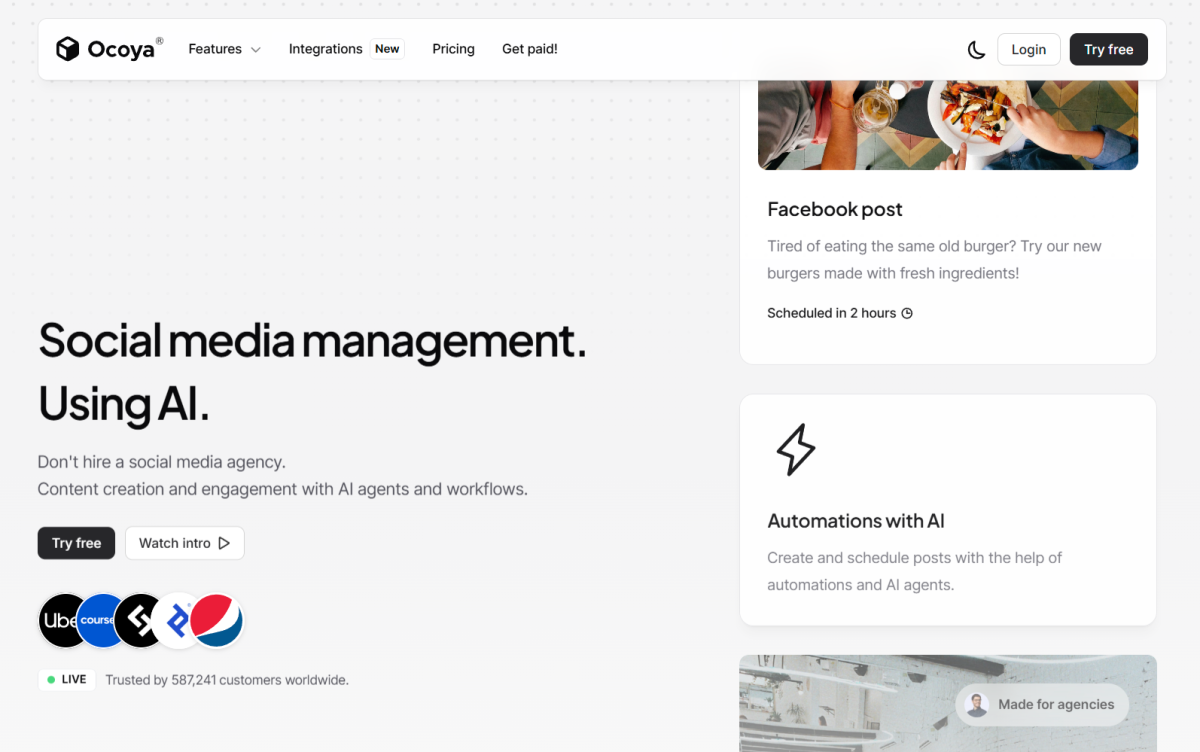
Ocoya is the most genuinely social-media-first. It has a visual content creator alongside text generation, plus scheduling and analytics built in. If you want a single tool for the full social workflow, Ocoya comes closest. The tradeoff is less depth in any one feature compared to specialists.
None of them solve the authenticity problem. That is not a product gap — it is a fundamental limitation of the approach.
The Detection Problem
Here is what changed in 2025 and accelerated through 2026: platforms got better at noticing, and audiences got better at reading.
LinkedIn's algorithm has been updated multiple times to deprioritise content that matches AI-generation patterns. Not perfectly — many AI posts still perform fine — but the signal is there. Google's helpful content updates have affected AI-generated blog-to-social pipelines. The easy wins of bulk-posting AI content to rank are largely gone.
More practically: people can tell. The phrasing, the rhythm, the structure — once you have read enough AI-generated LinkedIn posts, you can spot them reliably. Communities on Reddit are open about this: "I can tell immediately," "it all sounds the same," "I stopped engaging with anything that sounds like that." That audience fatigue is a real cost.
Warning: Using AI generators without a human editing layer does not just risk bad content — it risks your audience noticing and disengaging.
How to Use AI Generators Without Sounding Like a Robot
The workflow that works:
Use AI for the first draft, never the final post. Let it generate five options. Read them. Identify what is actually useful — maybe a framing, maybe a statistic worth verifying, maybe a structure worth borrowing. Then rewrite in your voice.
Feed it real specificity. Not "write a LinkedIn post about productivity." Write: "write a LinkedIn post about how our team cut standup time from 45 minutes to 15 by switching to async updates. Tone: direct, a little wry. Audience: engineering managers at startups. No buzzwords." The difference in output quality is enormous.
Maintain a human approval gate. Not just for accuracy — for authenticity. Does this sound like us? Would our best community manager post this? If the answer is no, the AI output is not finished.
Mix AI drafts with original thinking. The posts that perform best are the ones that contain an observation or insight the AI could not have generated — a specific customer conversation, a counterintuitive finding from your own data, a view that would get pushback from someone. AI is good at synthesising. It is bad at having a genuine point of view.
The Honest Verdict on AI Social Media Generators in 2026
They save time. That part is real. A content team that used to spend three hours writing a week of social posts can do it in thirty minutes with AI assistance. For brands that were not posting consistently because of capacity constraints, that is a genuine improvement.
The cost is authenticity. Not always, not every post — but the more you lean on AI without a strong editing layer, the more your content converges toward the mean. And on social media, the mean is forgettable.
The brands that are using AI generators most effectively have one thing in common: they use AI to compress the drafting phase, not to replace the thinking phase. They have a human in the loop who knows what their audience sounds like, who can tell the difference between a post that was written fast and a post that was written by a robot, and who edits accordingly.
If you have that person, AI generators are a significant productivity tool. If you do not, you will post faster and lose your audience faster too.
The tool is only as good as the person reviewing its output. That is probably the most important thing to know about AI social media generators in 2026.